📌 MAROKO133 Breaking ai: Light-powered soft robot jumps 188 times without motor, c
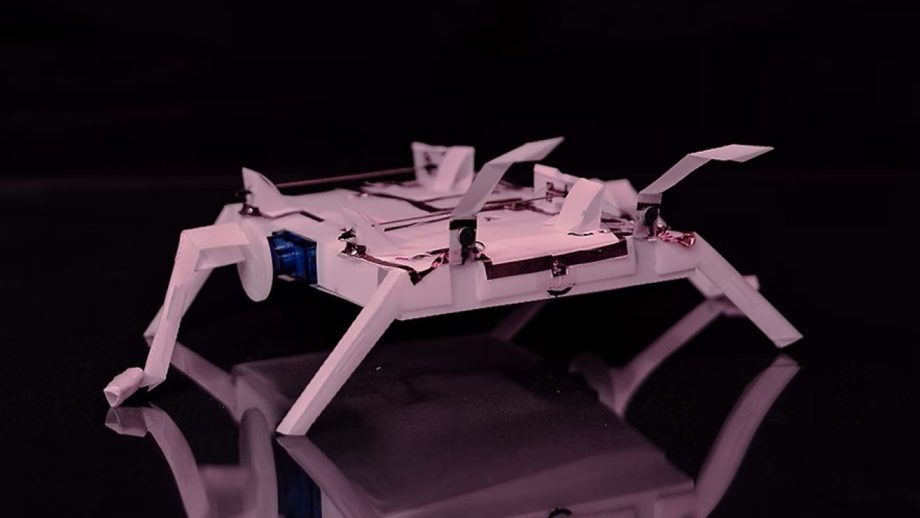
An insect-scale robot that jumps using only light has completed 188 continuous leaps without a single electronic component.
The soft machine bends, snaps and resets itself automatically, powered entirely by material physics instead of chips or wires.
The robot is built mainly from liquid crystal elastomers, a rubber-like material that changes shape when exposed to light. When illuminated, the material bends and stores elastic energy in a curved beam structure.
That stored energy releases in a snap, propelling the robot into the air. As it jumps, it casts a shadow that blocks the light source, allowing the material to cool and return to its original shape. The cycle then repeats.
There are no batteries, no onboard processors and no motors. The structure itself performs sensing, actuation and reset through geometry and material response.
The research was co-authored by Wenzhong Yan, who recently joined the Department of Mechanical and Aerospace Engineering at the University of California, Davis as an assistant professor.
His broader work focuses on soft robotics and mechanical intelligence, where materials are engineered to perform tasks typically handled by electronics.
Light drives the leap
The team initially expected the robot to jump only a handful of times under continuous illumination. Instead, it kept going. It completed 188 uninterrupted jumps in testing.
“That was exciting and a surprise,” Yan said. “I did not plan for that.”
The durability of the material also stood out. Researchers added extra weight to test performance limits. The robot showed no drop in function even when carrying up to 1,700 times its own body weight, roughly 300 milligrams.
The jumping mechanism relies on a simple physical principle: rapid deformation followed by snap-through instability. When light hits the liquid crystal elastomer, it contracts.
The curved beam stores that strain energy until it reaches a critical point, then releases it suddenly, launching the robot. The self-shadowing effect acts as a built-in control system, eliminating the need for circuitry.
Yan’s research trajectory has centered on this idea of embedding intelligence directly into materials. During his Ph.D., he developed folding robots that achieved autonomous behavior without computer chips, integrating sensing, control and actuation into structure.
Built-in mechanical intelligence
The light-powered jumper reflects that philosophy. Instead of programming movement, the team engineered geometry and material composition to create repetitive motion.
Beyond lab demonstrations, the researchers are exploring real-world deployment. One potential application is wildfire monitoring. The robots could carry sensors and move continuously across terrain.
“The rough idea is that they would [carry a sensor] and continuously jump. Once they detect smoke or a flame, they send a signal [to someone monitoring wildfires]. Basically, it would be a dynamic, distributed networking system that could detect lots of environmental factors.”
Such robots could also operate in collapsed buildings, radioactive zones or tight underground spaces where conventional machines struggle.
Yan is also investigating adaptive wearables that change stiffness on demand. “Imagine if your T-shirt could be very rigid if you needed it to be, to support you and whatever harm you are facing. When you don’t need it [to be supportive], it can be very flexible,” he said.
The light-powered jumping robot study was published in Advanced Materials.
🔗 Sumber: interestingengineering.com
📌 MAROKO133 Hot ai: Which Agent Causes Task Failures and When?Researchers from PSU
Share My Research is Synced’s column that welcomes scholars to share their own research breakthroughs with over 1.5M global AI enthusiasts. Beyond technological advances, Share My Research also calls for interesting stories behind the research and exciting research ideas. Contact us: [email protected]
Meet the authors
Institutions: Penn State University, Duke University, Google DeepMind, University of Washington, Meta, Nanyang Technological University, and Oregon State University. The co-first authors are Shaokun Zhang of Penn State University and Ming Yin of Duke University.
In recent years, LLM Multi-Agent systems have garnered widespread attention for their collaborative approach to solving complex problems. However, it’s a common scenario for these systems to fail at a task despite a flurry of activity. This leaves developers with a critical question: which agent, at what point, was responsible for the failure? Sifting through vast interaction logs to pinpoint the root cause feels like finding a needle in a haystack—a time-consuming and labor-intensive effort.
This is a familiar frustration for developers. In increasingly complex Multi-Agent systems, failures are not only common but also incredibly difficult to diagnose due to the autonomous nature of agent collaboration and long information chains. Without a way to quickly identify the source of a failure, system iteration and optimization grind to a halt.
To address this challenge, researchers from Penn State University and Duke University, in collaboration with institutions including Google DeepMind, have introduced the novel research problem of “Automated Failure Attribution.” They have constructed the first benchmark dataset for this task, Who&When, and have developed and evaluated several automated attribution methods. This work not only highlights the complexity of the task but also paves a new path toward enhancing the reliability of LLM Multi-Agent systems.
The paper has been accepted as a Spotlight presentation at the top-tier machine learning conference, ICML 2025, and the code and dataset are now fully open-source.
Paper:https://arxiv.org/pdf/2505.00212
Code:https://github.com/mingyin1/Agents_Failure_Attribution
Dataset:https://huggingface.co/datasets/Kevin355/Who_and_When
Research Background and Challenges
LLM-driven Multi-Agent systems have demonstrated immense potential across many domains. However, these systems are fragile; errors by a single agent, misunderstandings between agents, or mistakes in information transmission can lead to the failure of the entire task.
Currently, when a system fails, developers are often left with manual and inefficient methods for debugging:
Manual Log Archaeology : Developers must manually review lengthy interaction logs to find the source of the problem.
Reliance on Expertise : The debugging process is highly dependent on the developer’s deep understanding of the system and the task at hand.
This “needle in a haystack” approach to debugging is not only inefficient but also severely hinders rapid system iteration and the improvement of system reliability. There is an urgent need for an automated, systematic method to pinpoint the cause of failures, effectively bridging the gap between “evaluation results” and “system improvement.”
Core Contributions
This paper makes several groundbreaking contributions to address the challenges above:
1. Defining a New Problem: The paper is the first to formalize “automated failure attribution” as a specific research task. This task is defined by identifying the failure-responsible agent and the decisive error step that led to the task’s failure.
2. Constructing the First Benchmark Dataset: Who&When : This dataset includes a wide range of failure logs collected from 127 LLM Multi-Agent systems, which were either algorithmically generated or hand-crafted by experts to ensure realism and diversity. Each failure log is accompanied by fine-grained human annotations for:
Who: The agent responsible for the failure.
When: The specific interaction step where the decisive error occurred.
Why: A natural language explanation of the cause of the failure.
3. Exploring Initial “Automated Attribution” Methods : Using the Who&When dataset, the paper designs and assesses three distinct methods for automated failure attribution:
– All-at-Once: This method provides the LLM with the user query and the complete failure log, asking it to identify the responsible agent and the decisive error step in a single pass. While cost-effective, it may struggle to pinpoint precise errors in long contexts.
– Step-by-Step: This approach mimics manual debugging by having the LLM review the interaction log sequentially, making a judgment at each step until the error is found. It is more precise at locating the error step but incurs higher costs and risks accumulating errors.
– Binary Search: A compromise between the first two methods, this strategy repeatedly divides the log in half, using the LLM to determine which segment contains the error. It then recursively searches the identified segment, offering a balance of cost and performance.
Experimental Results and Key Findings
Experiments were conducted in two settings: one where the LLM knows the ground truth answer to the problem the Multi-Agent system is trying to solve (With Ground Truth) and one where it does not (Without Ground Truth). The primary model used was GPT-4o, though other models were also tested. The systematic evaluation of these methods on the Who&When dataset yielded several important insights:
– A Long Way to Go: Current methods are far from perfect. Even the best-performing single method achieved an accuracy of only about 53.5% in identifying the responsible agent and a mere 14.2% in pinpointing the exact error step. Some methods performed even worse than random guessing, underscoring the difficulty of the task.
– No “All-in-One” Solution: Different methods excel at different aspects of the problem. The All-at-Once method is better at identifying “Who,” while the Step-by-Step method is more effective at determining “When.” The Binary Search method provides a middle-ground performance.
– Hybrid Approaches Show Promise but at a High Cost: The researchers found that combining different methods, such as using the All-at-Once approach to identify a potential agent and then applying the Step-by-Step method to find the error, can improve overall performance. However, this comes with a significant increase in computational cost.
– State-of-the-Art Models Struggle: Surprisingly, even the most advanced reasoning models, like OpenAI o1 and DeepSeek R1, find this task challenging.- This h…
Konten dipersingkat otomatis.
🔗 Sumber: syncedreview.com
🤖 Catatan MAROKO133
Artikel ini adalah rangkuman otomatis dari beberapa sumber terpercaya. Kami pilih topik yang sedang tren agar kamu selalu update tanpa ketinggalan.
✅ Update berikutnya dalam 30 menit — tema random menanti!
