📌 MAROKO133 Update ai: From air to tank: New catalyst tech pumps out 110lb of fuel
As an effective blockade chokes the Strait of Hormuz and sends shipping costs soaring, a team of South Korean scientists has found a way to mine for oil in the one place no blockade can reach: the atmosphere.
Researchers at the Korea Research Institute of Chemical Technology (KRICT) have developed a technology that directly captures carbon dioxide (CO2) from industrial emissions and converts it into high-grade gasoline and naphtha.
For this, a proprietary catalyst and a streamlined process were developed that skip intermediate steps, immediately converting CO2 and hydrogen into liquid hydrocarbons.
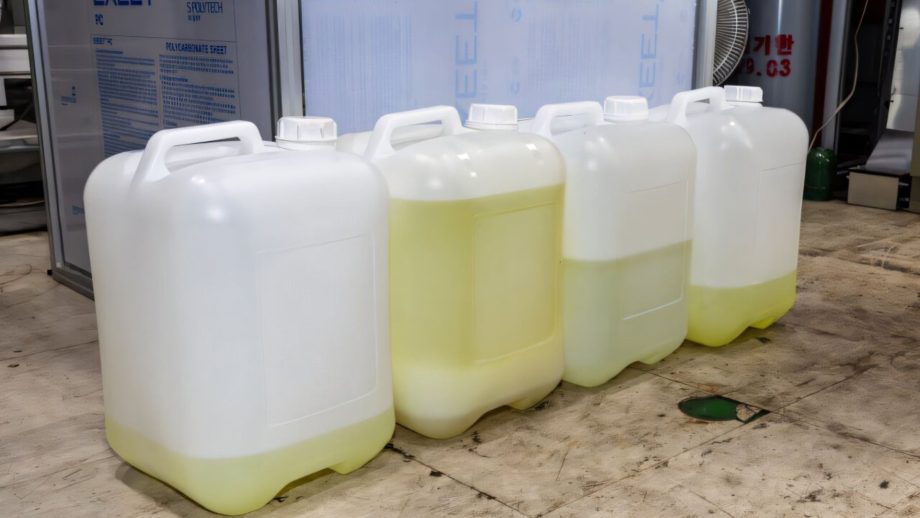
Notably, the new pilot plant is already producing 50 kilograms (110 pounds) of liquid fuel every day.
“Successful commercialization could substantially reduce dependence on imported petroleum and strengthen national energy security by establishing alternative carbon feedstock systems,” the team noted.
Direct hydrogenation
Regular carbon dioxide conversion relies on a cumbersome two-stage approach: first, the gas must be heated to over 800°C (1472°F) to drive the reverse water-gas shift reaction and produce carbon monoxide. This intermediate is then processed through Fischer–Tropsch synthesis under high pressure to create liquid fuel.
With these extreme temperature and pressure requirements, the process demands complex, multi-stage facilities that are both energy-intensive and expensive to maintain.
In this development, the team replaces this two-step conversion process with a streamlined direct hydrogenation method.
Using a specialized catalyst, CO2 and hydrogen were converted into liquid hydrocarbons in a single stage at much milder temperatures of around 330°C (626°F). This shortcut reduces energy consumption and complexity.
Moreover, it achieved a 50% synthesis yield of liquid hydrocarbons. It could pave the way for cost-effective, commercial-scale production of sustainable fuels such as gasoline and naphtha.
“The pilot plant’s daily output of 50 kg is roughly equivalent to three 20-liter jerrycans of fuel,” the researchers noted.
The success builds on the initial 5 kg-per-day mini-pilot. Following this, the joint research team successfully launched Korea’s first direct CO2 hydrogenation pilot plant, scaling production to 50 kg daily by late 2025.
This milestone serves as the foundation for the project’s next ambitious phase.
Large-scale production
The timing of this breakthrough is no accident. The 2026 Iran War is said to be choking off 20 percent of the world’s oil supply.
With 70% of South Korea’s crude oil flowing through the Strait of Hormuz, the current blockade has triggered a systemic crisis, exposing vulnerabilities in everything from petrochemicals and semiconductors to the national economy.
Three 20-liter jerrycans of fuel a day might seem small, but the roadmap is massive. The joint team — which includes heavyweights GS Engineering & Construction and Hanwha TotalEnergies — is already drafting blueprints for a commercial plant capable of producing 100,000 tons annually.
The development is important for Power-to-Liquids (PtL) systems, which can be integrated with renewable energy. This synergy enables the conversion of renewable electricity, captured CO2, and green hydrogen into carbon-neutral liquid fuels, creating a sustainable, high-efficiency energy cycle.
It could open the path to commercialization by offering a cost-effective, stable alternative to usual petroleum feedstocks for fuels and petrochemicals.
Ultimately, these advancements provide a streamlined, scalable path for replacing crude oil with sustainable, carbon-derived raw materials.
The findings were published in the journal ACS Sustainable Chemistry & Engineering.
🔗 Sumber: interestingengineering.com
📌 MAROKO133 Eksklusif ai: Salesforce rolls out new Slackbot AI agent as it battles
Salesforce on Tuesday launched an entirely rebuilt version of Slackbot, the company's workplace assistant, transforming it from a simple notification tool into what executives describe as a fully powered AI agent capable of searching enterprise data, drafting documents, and taking action on behalf of employees.
The new Slackbot, now generally available to Business+ and Enterprise+ customers, is Salesforce's most aggressive move yet to position Slack at the center of the emerging "agentic AI" movement — where software agents work alongside humans to complete complex tasks. The launch comes as Salesforce attempts to convince investors that artificial intelligence will bolster its products rather than render them obsolete.
"Slackbot isn't just another copilot or AI assistant," said Parker Harris, Salesforce co-founder and Slack's chief technology officer, in an exclusive interview with Salesforce. "It's the front door to the agentic enterprise, powered by Salesforce."
From tricycle to Porsche: Salesforce rebuilt Slackbot from the ground up
Harris was blunt about what distinguishes the new Slackbot from its predecessor: "The old Slackbot was, you know, a little tricycle, and the new Slackbot is like, you know, a Porsche."
The original Slackbot, which has existed since Slack's early days, performed basic algorithmic tasks — reminding users to add colleagues to documents, suggesting channel archives, and delivering simple notifications. The new version runs on an entirely different architecture built around a large language model and sophisticated search capabilities that can access Salesforce records, Google Drive files, calendar data, and years of Slack conversations.
"It's two different things," Harris explained. "The old Slackbot was algorithmic and fairly simple. The new Slackbot is brand new — it's based around an LLM and a very robust search engine, and connections to third-party search engines, third-party enterprise data."
Salesforce chose to retain the Slackbot brand despite the fundamental technical overhaul. "People know what Slackbot is, and so we wanted to carry that forward," Harris said.
Why Anthropic's Claude powers the new Slackbot — and which AI models could come next
The new Slackbot runs on Claude, Anthropic's large language model, a choice driven partly by compliance requirements. Slack's commercial service operates under FedRAMP Moderate certification to serve U.S. federal government customers, and Harris said Anthropic was "the only provider that could give us a compliant LLM" when Slack began building the new system.
But that exclusivity won't last. "We are, this year, going to support additional providers," Harris said. "We have a great relationship with Google. Gemini is incredible — performance is great, cost is great. So we're going to use Gemini for some things." He added that OpenAI remains a possibility as well.
Harris echoed Salesforce CEO Marc Benioff's view that large language models are becoming commoditized: "You've heard Marc talk about LLMs are commodities, that they're democratized. I call them CPUs."
On the sensitive question of training data, Harris was unequivocal: Salesforce does not train any models on customer data. "Models don't have any sort of security," he explained. "If we trained it on some confidential conversation that you and I have, I don't want Carolyn to know — if I train it into the LLM, there is no way for me to say you get to see the answer, but Carolyn doesn't."
Inside Salesforce's internal experiment: 80,000 employees tested Slackbot with striking results
Salesforce has been testing the new Slackbot internally for months, rolling it out to all 80,000 employees. According to Ryan Gavin, Slack's chief marketing officer, the results have been striking: "It's the fastest adopted product in Salesforce history."
Internal data shows that two-thirds of Salesforce employees have tried the new Slackbot, with 80% of those users continuing to use it regularly. Internal satisfaction rates reached 96% — the highest for any AI feature Slack has shipped. Employees report saving between two and 20 hours per week.
The adoption happened largely organically. "I think it was about five days, and a Canvas was developed by our employees called 'The Most Stealable Slackbot Prompts,'" Gavin said. "People just started adding to it organically. I think it's up to 250-plus prompts that are in this Canvas right now."
Kate Crotty, a principal UX researcher at Salesforce, found that 73% of internal adoption was driven by social sharing rather than top-down mandates. "Everybody is there to help each other learn and communicate hacks," she said.
How Slackbot transforms scattered enterprise data into executive-ready insights
During a product demonstration, Amy Bauer, Slack's product experience designer, showed how Slackbot can synthesize information across multiple sources. In one example, she asked Slackbot to analyze customer feedback from a pilot program, upload an image of a usage dashboard, and have Slackbot correlate the qualitative and quantitative data.
"This is where Slackbot really earns its keep for me," Bauer explained. "What it's doing is not just simply reading the image — it's actually looking at the image and comparing it to the insight it just generated for me."
Slackbot can then query Salesforce to find enterprise accounts with open deals that might be good candidates for early access, creating what Bauer called "a really great justification and plan to move forward." Finally, it can synthesize all that information into a Canvas — Slack's collaborative document format — and find calendar availability among stakeholders to schedule a review meeting.
"Up until this point, we have been working in a one-to-one capacity with Slackbot," Bauer said. "But one of the benefits that I can do now is take this insight and have it generate this into a Canvas, a shared workspace where I can iterate on it, refine it with Slackbot, or share it out with my team."
Rob Seaman, Slack's chief product officer, said the Canvas creation demonstrates where the product is heading: "This is making a tool call internally to Slack Canvas to actually write, effectively, a shared document. But it signals where we're going with Slackbot — we're eventually going to be adding in additional third-party tool calls."
MrBeast's company became a Slackbot guinea pig—and employees say they're saving 90 minutes a day
Among Salesforce's pilot customers is Beast Industries, the parent company of YouTube star MrBeast. Luis Madrigal, the company's chief information officer, joined the launch announcement to describe his experience.
"As somebody who has rolled out enterprise technologies for over two decades now, this was practically one of the easiest," Madrigal …
Konten dipersingkat otomatis.
🔗 Sumber: venturebeat.com
🤖 Catatan MAROKO133
Artikel ini adalah rangkuman otomatis dari beberapa sumber terpercaya. Kami pilih topik yang sedang tren agar kamu selalu update tanpa ketinggalan.
✅ Update berikutnya dalam 30 menit — tema random menanti!
