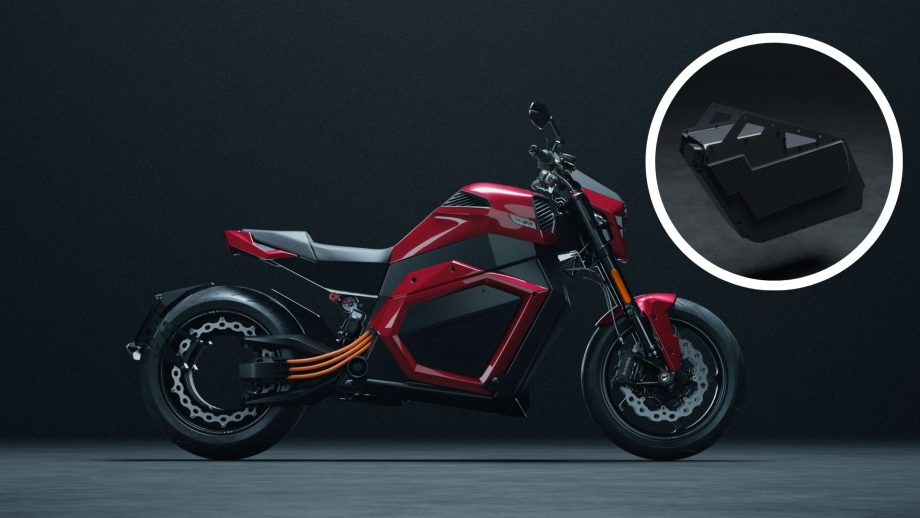
📌 MAROKO133 Update ai: World’s first solid-state battery motorcycle debuts at CES
Verge Motorcycles has taken solid-state battery technology out of the lab and onto public roads.
Unveiled during CES 2026, the company’s latest production-ready motorcycle achieves ten-minute fast charging and a claimed range of up to 370 miles.
The move positions Verge as the first manufacturer to deliver production motorcycles powered by solid-state batteries, a milestone long anticipated across the electric vehicle industry.
The Finnish electric motorcycle maker already stands out for its hubless in-wheel motor design. Now, it has paired that innovation with a battery system many automakers still consider years away from mass adoption.
Developed alongside technology company Donut Lab, the new battery enables faster charging, longer range, and higher durability than conventional lithium-ion packs. Verge plans to deliver the first customer bikes with this technology in the coming months.
Solid-state leap forward
Solid-state batteries replace liquid or gel electrolytes with solid materials.
This design improves safety, energy density, and longevity.
Major carmakers have tested the technology for years, but few have moved beyond prototypes. Verge says it has crossed that threshold.
“The use of solid state battery technology to motorcycles in production is a historic breakthrough shaking up the entire automotive industry,” says Tuomo Lehtimäki, CEO of Verge Motorcycles.
“Verge’s close development work with Donut Lab, along with battery pack testing and validation, has reached the point where we can implement the technology in the new evolution of Verge TS Pro model.”
Verge released the next evolution of the TS Pro last November at the EICMA motorcycle show in Milan.
The TS Pro now serves as the first production platform for the solid-state battery pack.
Verge says the battery supports ultra-fast charging and lasts for the motorcycle’s entire service life.
Performance meets practicality
The Verge TS Pro combines the new battery with a redesigned Donut 2.0 motor. The motor weighs 50 percent less than its predecessor while delivering the same power.
Torque reaches 1,000 Nm. Verge says the bike accelerates from 0 to 62 mph in 3.5 seconds.
Charging speed marks one of the most striking gains. Ten minutes of charging can add up to 186 miles of range. Verge also offers an extended-range option at purchase.
That configuration increases range from 217 miles to a claimed 370 miles on a single charge. Verge says the upgraded battery does not affect the motorcycle’s price.
Safety and broader impact
Safety sits at the center of Verge’s solid-state push. Unlike conventional lithium-ion batteries, solid-state packs do not catch fire.
Verge says the batteries operate stably across all operating temperatures.
“Donut Lab’s next-generation solid-state battery technology is a result of years of development work,” says Donut Lab CTO Ville Piippo.
“We are now ready to bring truly exceptional technology to the electric mobility market.”
Verge also points to sustainability. The batteries rely on materials that are abundant worldwide, reducing supply risks.
Donut Lab says the technology can extend beyond motorcycles to cars, trucks, robotics, and stationary energy storage.
You can explore all CES 2026 stories and coverage from the IE team by clicking here.
🔗 Sumber: interestingengineering.com
📌 MAROKO133 Eksklusif ai: The Hard Numbers Show That the Results of NYC Congestion
Surprise! A public policy initiative panned by drivers and pro-car pundits turned out to instead be a roaring success that improved traffic congestion, road safety, and even reduced pollution — a godsend not just for those living in Manhattan, but for transit riders, drivers, and outer-borough residents.
Congestion pricing is a policy which charges drivers a toll of up to $9 for using surface-roads below Manhattan’s 60th street, an area known as the Congestion Relief Zone (CRZ), which is enforced by over 1,400 license-plate cameras.
Critics, including president Donald Trump, assailed the program during the runup period, but after a full year of congestion pricing, the New York Times reports massive wins for people living in Manhattan and beyond.
Since the CRZ went into effect on January 5, 2025, the NYT reports an 11 percent decrease in daily vehicle traffic throughout the borough’s central business district. In real terms, that comes out to about 73,000 fewer vehicles per day, or 27 million fewer trips than expected in the program’s first year alone.
As a result, those who do drive or use surface-level transit like buses experience much less traffic. Over the past year, average travel speeds increased 4.5 percent in the congestion zone, while the rest of New York City experienced a 1.4 percent increase. Local bus speeds are also up noticeably, increasing 2.4 percent in the CRZ, and 0.8 percent throughout the rest of the city.
The gains haven’t just been about convenience, either. The reduced volume of cars has led to marked improvements in pollution and traffic safety for motorists, cyclists and pedestrians. It also raised more than half a billion dollars for the city’s beleaguered public transportation system.
“It turns out that mostly when people say ‘New York is noisy’ they really mean ‘cars are noisy,’” Grant Louis of Manhattan told the NYT.
And even the commuters who criticized the program are gaining back untold hours of their life that would have otherwise been spent in traffic. Those who trudge into the city via the Lincoln Tunnel, for example, saw travel speeds increase by an average of almost 25 percent, while average speeds in the Holland tunnel were 51 percent faster compared to pre-congestion data.
Even outside of New York City, people noticed a marked difference in vehicular traffic, confirming earlier studies which found positive run-off effects in surrounding communities.
“I supercommute weekly from Kingston by bus,” resident Rob Bellinger told the paper. “Each week, my bus round trip is 30-60 minutes faster than it was before congestion pricing.”
The implications are clear for other busy metropolitan areas: even gently discouraging unnecessary automotive traffic can have immense benefits for a city’s wellbeing.
More on transit: It’s Starting to Feel a Lot Like Tesla’s Robotaxi Program Is Mostly Smoke and Mirrors
The post The Hard Numbers Show That the Results of NYC Congestion Pricing Have Been Absolutely Incredible appeared first on Futurism.
🔗 Sumber: futurism.com
🤖 Catatan MAROKO133
Artikel ini adalah rangkuman otomatis dari beberapa sumber terpercaya. Kami pilih topik yang sedang tren agar kamu selalu update tanpa ketinggalan.
✅ Update berikutnya dalam 30 menit — tema random menanti!
