📌 MAROKO133 Breaking ai: Ancient black hole breaks physics laws by growing 13 time
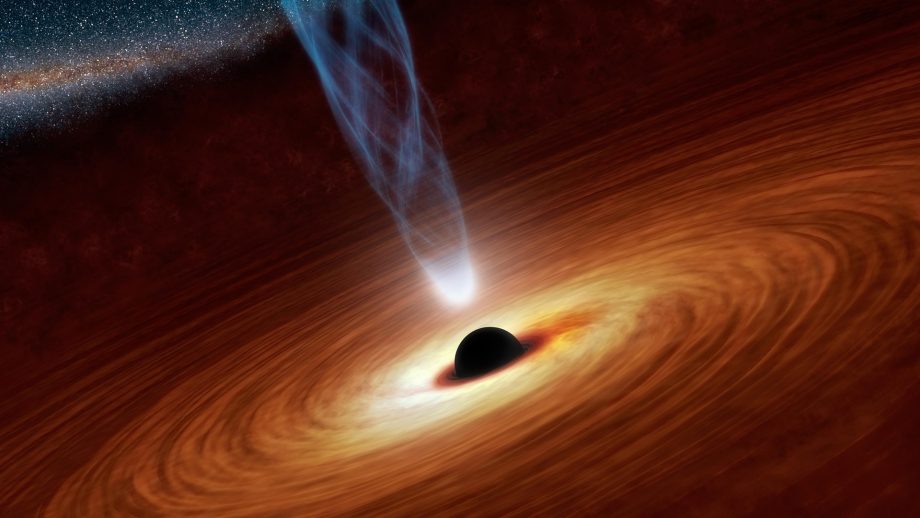
Japanese astronomers have discovered an extraordinary supermassive black hole in the early universe that is growing at a nearly impossible pace, while producing intense X-ray and radio emissions simultaneously.
The find, made by scientists at Waseda University and Tohoku University in Japan, challenges long-standing theories and suggests that the key physical processes operating in the young cosmos remain poorly understood.
The team spotted the distant quasar, an actively feeding supermassive black hole, using observations from the Subaru Telescope. It existed when the universe was less than 1.5 billion years old.
It is undergoing extremely rapid accretion while simultaneously shining brightly in X-rays and producing strong radio emission from a jet. These are features that many theoretical models do not expect to coexist.
The Eddington limit
Supermassive black holes, which can contain millions to billions of times the mass of the sun, sit in the centers of most galaxies. They grow by pulling in surrounding gas, typically hydrogen and helium, from their host galaxies.
As gas spirals inward, it can power a compact region of hot plasma known as a corona which emits X-rays. Additionally, some supermassive black holes form a jet of outflowing material that emits strongly at radio wavelengths.
However, if gas falls toward a supermassive black hole too quickly, radiation from the gas starts to push back on the material flowing behind it. It causes the flow to slow down.
Credit: National Astronomical Observatory of Japan (NAOJ)
This sets a self-regulating Eddington limit, which is, in essence, a speed limit on how fast gas can flow in. However, even the Eddington limit is broken sometimes, enabling rapid mass build-up over short cosmic timescales.
In rare cases, black holes are thought to temporarily exceed this limit through so-called super-Eddington accretion, allowing them to gain mass rapidly over short cosmic timescales. However, such extreme growth is usually expected to suppress high-energy radiation and weaken jet activity.
Breaking physics laws
To discover whether such extreme growth happens in the early universe, the team used Subaru’s near-infrared spectrograph MOIRCS. They measured the motion of gas near the black hole and estimated its mass from the Mg II emission line.
X-ray data revealed that the black hole is accreting material at roughly 13 times the Eddington limit, placing it among the fastest-growing black holes known at this mass scale.
“This discovery may bring us closer to understanding how supermassive black holes formed so quickly in the early Universe,” Sakiko Obuchi, PhD, a researcher at Waseda University and lead author of the study pointed out.
In addition, the researchers observed that the object shines brightly in X-rays and emits strong radio waves. This was clear evidence of an active hot corona and a powerful jet. Current models of super-Eddington accretion predict that these features should be weakened or absent when growth becomes so extreme.
“We want to investigate what powers the unusually strong X-ray and radio emissions, and whether similar objects have been hiding in survey data,” Waseda concluded in a press release.
The team believes the quasar is caught in a short-lived transition, in which a rapid inflow of gas pushed it beyond the Eddington limit, while its X-ray corona and radio jet persisted briefly before fading.
If confirmed, the observation could offer a snapshot of time-variable black hole growth in the early universe, which is difficult to capture observationally. It may also help explain rapid galaxy growth, as powerful jets can shape star formation during extreme black hole growth.
The study has been published in The Astrophysical Journal.
🔗 Sumber: interestingengineering.com
📌 MAROKO133 Breaking ai: Private Space Station Being Assembled for Launch Edisi Ja
The International Space Station is scheduled to be retired in 2030, bringing an end to three decades of cutting-edge space research. What comes next remains to be seen, as several private companies compete for NASA funding to once again establish an outpost in our planet’s orbit — outside of China’s existing Tiangong space station, that is.
As part of Phase 2 of its Commercial Space Stations program, NASA has been seeking feedback from its industry partners. While we have yet to find out the requirements, let alone which company — or companies — the agency will choose to move onto the next phase, some firms have started making tangible progress.
As Ars Technica reports, space startup Vast has opted to build a smaller and more feasible interim station, dubbed Haven-1, which will serve as the precursor for much larger outposts capable of continuous habitation in the more distant future.
Vast first showed off flashy renders of the capsule in October 2024, including luxuriously plush beds, enormous domed glass windows, and a minimalist interior layout. However, how much the final product will resemble these renders remains to be seen.
The company’s CEO, Max Haot, told Ars that “we reached the key milestone of fully completing the primary structure, and some of the secondary structure” last week. The company has since kicked off “clean room integration” ahead of a “full test campaign” with NASA scheduled for later this fall. The hope is to launch the capsule in early 2027.
Haven-1 will rely heavily on SpaceX’s existing hardware. The small capsule is designed to launch on a single SpaceX Falcon 9 and dock with a Crew Dragon spacecraft.
During its inaugural mission, the goal is to first check whether the capsule can stay pressurized and maintain its attitude before allowing any humans on board, Haot told Ars, a process that could take anywhere from two weeks to three years.
“The nominal plan is for a two-week mission,” he said, “and we have one fully contracted with SpaceX, as well as a second one that we have a deposit and an option on.”
The company is still waiting to hear from NASA about what its requirements will be for its commercial space station program until it decides whether to compete for funding.
Last week, lawmakers called on NASA to accelerate its plans to replace the ISS ahead of its decommissioning a mere four years from now.
“With the current budget, we don’t think more than two winners is reasonable, but it should absolutely be two in the best interest of the country,” Haot told Ars. “If there was a bigger budget, obviously, three would be great.”
There are several other companies looking to make inroads in the space. Voyager Technologies recently moved into “full-scale development” of its “Starlab” station. Jeff Bezos’ Blue Origin is still exploring its options after showing off plans for its “Orbital Reef.”
Axiom Space is also hoping to launch the “world’s first commercial space station.” The company released a detailed plan for its modular station last week, with a goal of launching as early as 2028.
But given the degree of complexity involved, plenty of questions remain about what will ultimately replace the ISS.
More on private space stations: Bonkers New Space Station Expands to Full Size From Single Capsule
The post Private Space Station Being Assembled for Launch appeared first on Futurism.
🔗 Sumber: futurism.com
🤖 Catatan MAROKO133
Artikel ini adalah rangkuman otomatis dari beberapa sumber terpercaya. Kami pilih topik yang sedang tren agar kamu selalu update tanpa ketinggalan.
✅ Update berikutnya dalam 30 menit — tema random menanti!
